The traffic lights tell drivers when to STOP, go, turn turn on the red, yield to vehicles and watch for potential hazards on the road. As a new driver, resident, visitor or getting ready to pass the driving test in Kuwait, it is essential to understand the signal indications of traffic signs, road markings, and signage.
This guide explains Kuwait traffic signal and road sign meanings and functions, and behaviors of road users in response to these signs.
What Are Traffic Signals in Kuwait?
A traffic signal refers to a device or an indicator that regulates or guides the movement of a vehicle. They include illuminated traffic lights, directional arrows, pedestrian signals, and other signal systems at intersections and on streets and roads.
These road-control devices are used for various reasons:
- Traffic lights: Control traffic at certain locations, such as intersections.
- Regulatory signs: Warn of restrictions, prohibitions, traffic-control directions, and actions required.
- Warning signs: Alert drivers when there is a danger, changing road conditions, and preparatory intersections.
- Road markings: Signal lane boundaries and stopping positions, turning directions, parking restrictions, and all other directions.
It is knowing these differences that can help drivers to respond correctly rather than assuming every road sign is a traffic light.
What Do Traffic Light Colors Mean in Kuwait?
Traffic Light colors are used to have a basic control of traffic at intersections

Red traffic light
A red light requires the driver to stop at the applicable stop line and/or stop point. Don’t cross the intersection on a red signal.
Remain stopped until the signal permits movement or an authorized officer gives a different instruction.
Yellow or amber traffic light
Drivers should plan to safely stop at the crossroads in time, not to drive through them driving at excessive speeds.
When it is no longer reasonably possible, don’t make dangerous or unexpected stops, and drive slowly following the rules and conditions.
Green traffic light
The green light allows you to go and does not mean that the way is clear.
If there are pedestrians, vehicles still crossing the intersection, emergency vehicles, and other hazards.
Directional arrows
A directional arrow’s operation or direction is guided or indicated in the direction indicated. Instruction should be followed by the arrow indicating – and not the neighboring lane – which lane is intended for the drivers.
Check traffic, pedestrians, and obstructions even if a turn is allowed.
Pedestrian signals
Pedestrian signals communicate to pedestrians whether they can move in a crossing movement or not. Use only the designated crossing area and follow the signal displayed.
Drivers approaching a pedestrian crossing should slow down when necessary and give way as required. Never assume a pedestrian has seen your vehicle.
1. Road Markings and Road Directions in Kuwait
Signs line the roadway to guide traffic and to provide information. Directional signs also indicate to a driver where he or she should go next, or what action the driver should take.

Stop lines, lane arrows, center lines, crosswalks and lane markings to keep vehicles from crowding intersections should all be particularly noted by drivers.
| Road marking or direction | Meaning and what drivers should do |
|---|---|
| Line to Stop Near Stop Mark | Identifies the stopping position associated with a stop instruction. Stop before the applicable line. |
| Stop and Give Priority Ahead | Warns that a stop and priority-control point is approaching. Slow down, prepare to stop, and follow the actual control sign. |
| Line to Stop Near Traffic Policeman | Indicates a stopping position when directed by an authorized traffic officer. Stop where instructed. |
| Road Curve | Indicates a bend or curved road. Reduce speed as appropriate and remain within your lane. |
| Must Turn to Right | Requires or directs traffic to turn right, subject to the sign’s placement and applicable rules. |
| Must Turn to Left | Requires or directs traffic to turn left. |
| Turn to Right or Left | Indicates that a right or left turn is permitted or required, depending on the sign design and location. |
| Cross Road Ahead with Give Way Sign | Warns of an approaching crossing or intersection where a give-way requirement applies. Prepare to yield as indicated. |
| Must Go Straight | Indicates that drivers must continue straight rather than make a prohibited turn. |
| Stop at the Line – Main Road Two Way | Identifies a stopping position at a junction with a two-way main road. Stop and assess traffic before entering. |
| Priority for Traffic Coming from Left | Indicates that traffic approaching from the left has priority at the relevant junction. Yield as required. |
| Stop at the Line – Side Road to Main Road One Way | Identifies a stop position where a side road meets a one-way main road. Check the permitted direction of traffic before entering. |
| Don’t Enter Before Area Clear | Warns drivers not to enter a section unless there is sufficient space to proceed without blocking traffic. |
| No Traffic on Yellow Strip Line | Indicates a restriction associated with a designated yellow-marked area. Follow the actual marking and its applicable restrictions. |
| Parking Zone | Identifies an area designated for parking, subject to posted conditions and restrictions. |
| No Stopping/Parking | Indicates that stopping or parking is prohibited in the designated area, as specified by the sign or marking. |
| Bus Stop | Identifies a designated bus stopping or boarding area. Do not obstruct it. |
| Straight or Turn Left | Indicates the permitted direction of travel is straight ahead or left. Follow the lane marking and associated sign. |
| Turn Right or Left | Directs or permits movement to the right or left, according to the applicable sign. |
| Roundabout | Directs traffic toward a roundabout or identifies the roundabout movement. Follow lane guidance and priority rules. |
| Turn Right | Directs traffic to turn right where the instruction applies. |
| Straight Ahead | Indicates that traffic should continue straight ahead. |
| Keep Either Side | Indicates that an obstruction or traffic island may be passed on either side, as shown by the sign. |
| Main Road | Identifies a main road or the route designated as the principal road. Observe the actual priority controls at junctions. |
| Side Road | Identifies a side road or an approaching side-road connection. Watch for vehicles entering or crossing. |
| Middle Line | Identifies the center line or a central reference marking separating traffic directions or road space. Follow its specific pattern. |
| Dividing Line | Separates lanes or traffic streams. Do not cross a continuous line where crossing is prohibited. |
| No Overtaking | Indicates an overtaking restriction. Remain behind the vehicle ahead until overtaking is permitted. |
| No Overtaking on Opposite Way | Indicates a restriction against overtaking into opposing traffic space. Do not move into the opposing lane to pass. |
| Pedestrian Crossing Ahead | Warns of an upcoming pedestrian crossing. Reduce speed as appropriate and watch for pedestrians. |
| Mark Between Same Direction | Identifies a line separating traffic lanes traveling in the same direction. Follow the lane boundaries and permitted lane changes. |
| Priority for Your Vehicle | Indicates a priority arrangement in which your vehicle has priority over specified conflicting traffic. Proceed cautiously and follow any additional controls. |
2. Information and Service Signs in Kuwait

Information signage and service signage guide drivers to facilities, on-the-way information, and relating to useful places on a trip. Parking facilities and hospitals, patrol stations, and highway entrances and exits may be shown.
| Information or service sign | Meaning and what drivers should know |
|---|---|
| Parking | Indicates a designated parking facility or parking area. Check for any restrictions, payment requirements, or time limits. |
| End of Highway | Indicates the end of a highway section or the transition to a different road type. Adjust to the new road conditions. |
| Highway Begins | Indicates the start of a highway or controlled-access road section. Follow the posted speed limit and entry instructions. |
| Rest | Indicates a rest area or designated place where drivers may stop, if available and permitted. |
| Patrol Station | Identifies a patrol station or designated patrol-related facility. |
| U Turn | Indicates a location or route associated with a U-turn. Make the maneuver only where permitted and safe. |
| Dead End | Indicates that the road does not continue through to another road. Prepare to turn around or follow the available route. |
| Priority for Your Vehicle | Indicates a priority arrangement applying to your approach. Confirm the actual sign and yield whenever required. |
| Hospital | Indicates a hospital or hospital-related location. Avoid obstructing access routes and emergency vehicles. |
| Ambulance | Identifies an ambulance-related facility or service. Follow any associated access restrictions. |
| No Learn Drive | Indicates a restriction on learner-driver training in the designated area, where applicable. Follow the posted restriction. |
| Distance to Exit Markers (100, 200, 300) | Provides distance information associated with an upcoming exit. Use it to prepare for the correct lane and avoid abrupt maneuvers. |
| No Trucks | Prohibits trucks or specified heavy vehicles from entering the restricted road or area, according to the sign. |
Highway and exit signs
Highway Signs are extremely beneficial for drivers between the city and the main roads of Kuwait.
An advance distance marker allows drivers to make preparations for going over an exit. If a vehicle is coming out of the lane, look at the pattern of the lane beforehand, use indicators to change lanes, and do not brake suddenly or turn across a solid lane marker.
3. Prohibition and Regulatory Signs in Kuwait

There are restrictions and instructions found on regulatory signs. They can prevent some vehicles from passing, impose size or weight restrictions, forbid turns or bends, set speed restrictions or mandate stopping.
If these signs are ignored, it could jeopardize the safety of other road users, and could trigger traffic fines.
| Regulatory sign | Meaning and required response |
|---|---|
| No Buses | Prohibits buses from entering or using the designated road or area, subject to the sign’s scope. |
| No Trucks Length Limit | Indicates a truck-length restriction or a maximum permitted vehicle length. Check the displayed limit and vehicle dimensions. |
| No Parking on Even Days | Indicates a parking restriction associated with even-numbered dates, if that is the meaning shown by the actual sign. Confirm the days, hours, and local conditions. |
| No Pedestrian Crossing | Prohibits pedestrian crossing at the designated location. Use an authorized crossing route. |
| No Overtaking | Prohibits overtaking within the area covered by the restriction. |
| End of Overtaking | Indicates the end of an overtaking restriction. Overtake only when otherwise permitted and safe. |
| No Parking | Prohibits parking in the designated area. Check whether separate stopping restrictions also apply. |
| Stop Police | Directs drivers to stop for a police or authorized traffic-control checkpoint, as indicated. Follow officers’ instructions. |
| Custom | Indicates a customs checkpoint or customs-controlled area. Follow inspection and entry instructions. |
| No Entry | Prohibits entry from the direction in which the sign faces. Do not enter against the restriction. |
| School | Identifies a school-related area or warns of a school zone, depending on the actual sign. Slow down when appropriate and watch for children. |
| No Traffic All Vehicles | Prohibits vehicle traffic in the designated area, subject to any stated exceptions. |
| No Left Turn | Prohibits left turns at the controlled junction or location. |
| No Parking on Single Days | Indicates a parking restriction associated with odd-numbered dates, if confirmed by the actual sign. Check the applicable conditions. |
| No Parking Stopping | Indicates a restriction on parking and possibly stopping. Follow the precise symbol and wording on the sign. |
| No Traffic Both Sides | Indicates a restriction on traffic from both directions or access from both sides, depending on the sign design. Verify the actual symbol before explaining it as a legal rule. |
| Handle Stop | The supplied label is unclear. Identify the original sign image before assigning a meaning; do not publish this wording as an established official sign name without verification. |
| No U Turn | Prohibits turning the vehicle around in a U-shaped maneuver at the designated location. |
| Width Limit | Restricts vehicles wider than the displayed maximum width. Check the vehicle and load dimensions. |
| Height Limit | Restricts vehicles taller than the displayed maximum height. Account for the full height of the vehicle and its load. |
| No Traffic | Prohibits the type of traffic indicated by the sign. Check whether the restriction applies to all vehicles or a specific category. |
| No Horn | Prohibits the use of vehicle horns in the designated area, subject to applicable exceptions. |
| Speed Limit | Specifies the maximum permitted speed or another displayed speed restriction. Follow the number shown and adjust further when conditions require. |
| Deadline of Maximum Speed | The supplied wording likely refers to the end of a maximum-speed restriction. Verify the sign image and official designation before publishing. |
| Priority for Approaching Vehicles | Requires drivers to yield to approaching traffic where the sign’s priority rule applies. |
| Axle Weight Limit | Restricts the permitted weight carried by an axle or axle group, as indicated. |
| No Traffic on Yellow Strip Line | Indicates a restriction related to a yellow-marked road area. Follow the actual marking and applicable instructions. |
No-entry and turning restrictions
A no-entry sign is a sign that usually stops car park access starting at the sign’s direction. It is not about quietly “going for a walk.It is not about taking an “asking price” approach to entering.
Parking restrictions
Signs for parking may be either filled in to indicate that there is no parking allowed, or an annotation may be affixed which states that parking is not allowed at all after a certain hour.
The difference matters. parking restriction is not the same as a no-stopping restriction. Because an explanation of an odd-day or even-day parking sign may be false, be sure to check the sign symbol, any display time, and any other panels so this explanation does not appear on the Internet.
Vehicle dimension and weight limits
Court width, length, height, and axle-weight restrictions are in place to minimize damage to infrastructure and the risks on the road for certain vehicle sizes and weights.
Commercial vehicles, trucks, and buses, as well as vehicles towing over the size limit, should be brought to a halt at a restricted route sign before entering.
4. Warning Signs in Kuwait
Warning indicators tell drivers when there’s a potential danger, changes in the road alignment, a junction, crossing or other condition that warrants more attention.
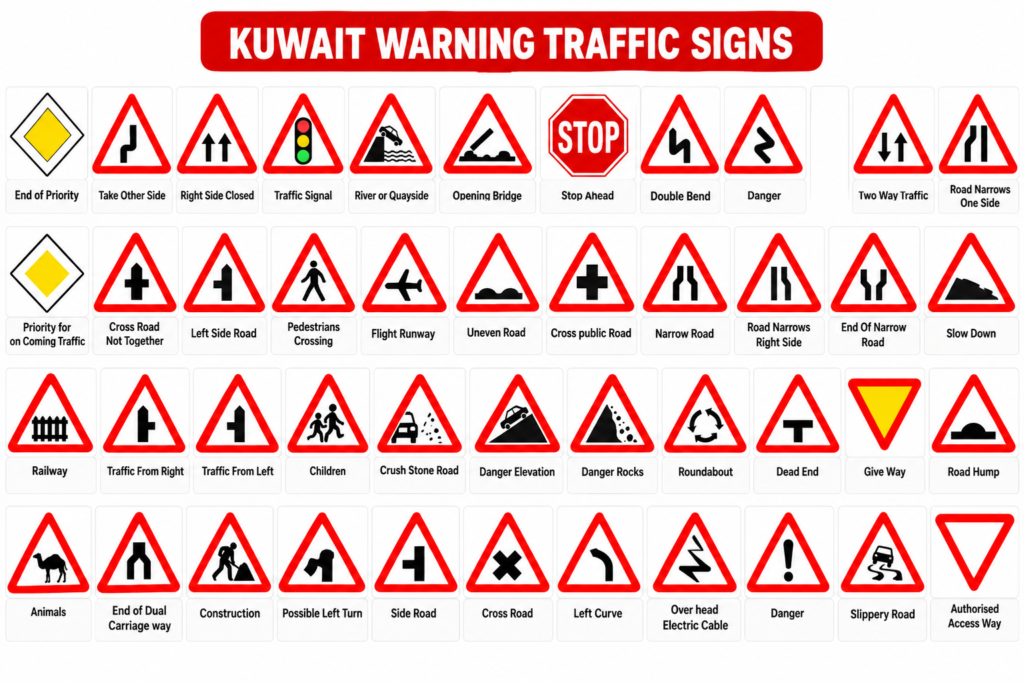
A warning sign usually conveys information about a condition that drivers need to prepare for, but not an intended restriction on a driver’s action.
| Warning sign | Meaning and recommended response |
|---|---|
| Take Other Side | The supplied label suggests that traffic should use the indicated alternative side or route. Confirm the original sign and follow its arrow or diagram. |
| Right Side Closed | Indicates that the right side of the road or a section of it is closed. Follow diversion signs and avoid entering the closed area. |
| Traffic Signal | Warns that traffic lights are ahead. Reduce speed as appropriate and prepare to respond to the signal. |
| River or Quayside | Warns of a waterside edge or a road beside a river, quay, or similar feature. Keep control of the vehicle and remain within the road boundary. |
| Opening Bridge | Warns of a bridge that can open to allow vessels or other traffic to pass. Follow signals, barriers, and instructions. |
| Stop | Indicates a stop-related control or warns of an approaching stop point, depending on the sign’s placement. Obey the actual stop sign or traffic control. |
| Double Bend | Warns of two successive bends. Adjust speed and maintain control throughout both curves. |
| Danger | Indicates a hazard or danger requiring attention. Identify any accompanying symbol or supplementary panel to understand the specific risk. |
| Two Way Traffic | Warns that traffic may travel in both directions on the road ahead. Stay within your lane and watch for opposing vehicles. |
| Road Narrows One Side | Warns that the road becomes narrower on one side. Reduce speed and watch for merging traffic or a restricted lane. |
| Left Side Road | Indicates a side road joining from the left. Watch for vehicles entering or crossing the road. |
| Pedestrians Crossing | Warns of a pedestrian crossing or likely pedestrian movement. Reduce speed as necessary and give way where required. |
| Flight Runway | The supplied label may refer to an aircraft-related warning, such as an aircraft crossing or low-flying aircraft area. Verify the sign image before stating the exact hazard. |
| Uneven Road | Warns of an uneven or irregular road surface. Reduce speed and maintain control. |
| Cross Public Road | Warns of an approaching public-road crossing or intersection. Check the actual sign diagram and prepare for crossing traffic. |
| Narrow Road | Warns that the road ahead becomes narrower. Adjust speed and position to pass safely. |
| Road Narrows Right Side | Warns that the right side of the road narrows. Watch for lane reductions and traffic merging from the left or right as applicable. |
| End of Narrow Road | Indicates that a previously narrowed road returns to a wider section. Continue to follow lane markings and other controls. |
| Slow Down | Advises drivers to reduce speed because of a hazard or road condition. Look for additional information about the reason. |
Common Traffic Signal Mistakes
Ignoring a STOP Sign
Stop signs must be obeyed as a STOP. That’s not the same as slowing down, not stopping. Stop and then look for traffic and take action accordingly as to whether it is safe and legal for you to do so.
Misunderstanding Give Way Signs
You may need to stop if the road is not clear. Avoid going into a junction just because you are slowed down.
Confusing No Parking With No Stopping
There may be some differences between parking and stopping regulations. Do not think the two terms are synonymous; read the real sign and any additional signage.
Changing Lanes at the Last Moment
Drivers sometimes notice an exit or turning instruction too late and attempt a sudden lane change. Check direction signs early, use mirrors, signal appropriately, and move only when safe and permitted.
Ignoring Road Markings
Lane arrows, stop lines, dividing lines, and restricted areas are all beneficial. If a lane instruction or road restriction reads with a specific direction, that is the direction to follow even if there appears to be a general direction.
Driving Too Fast Near Warning Signs
Warning sign – a signal indicating a potential hazard. Slow down as necessary, and make appropriate adjustments to driving speed to the road, visibility, traffic, and weather.
Assuming Green Means the Intersection Is Clear
A green signal does not remove the need to check for pedestrians, vehicles already in the intersection, and blocked exit lanes. Proceed only when you can do so safely.
Related driving and traffic guides
Frequently Asked Questions (FAQs)
What kinds of traffic signals in Kuwait?
Illuminated traffic lights, directional arrows and pedestrian signals control or advise road traffic are all examples of traffic signals.
What does red traffic light indicate in Kuwait?
Red light – stop before the stop line.
What does a yellow traffic light mean?
A yellow or amber light warns that the signal is changing. Drivers should prepare to stop safely and avoid accelerating to beat the light.
What is the traffic light colour green?
When the way is clear, the driver is usually allowed to go when the green light is on, and nothing else is prohibiting him. Drivers must not still assume that pedestrians and vehicles has already completed their crossing.
Read More: South Subahiya Civil ID Collection: Everything You Need to Know
Final Words
The traffic signals in Kuwait are crucial and an essential aspect of understanding the country’s road laws and driving safely. Each of the traffic lights, road markings, warning signs, regulatory signs and information signs offers a specific instruction. Knowing those differences improves your judgment when making a turn, passing through hazards and when driving on roads you are not used to.
Comparing each sign with the official references in Kuwait will give the best result, checking translation for signs which are unclear and learning how to identify signs from computer generated pictures will also be helpful.