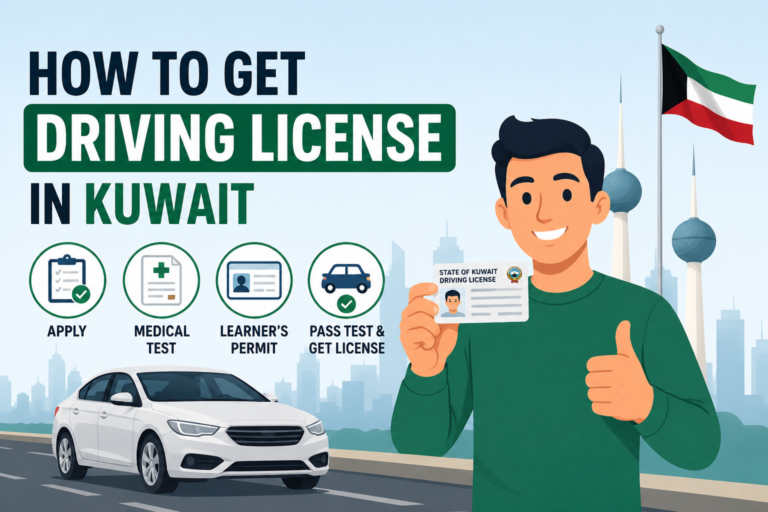
Reducing the risk of traffic accidents in Kuwait is important, whether you are a resident, expat, tourist, or just starting to drive. Kuwait has also made easy changes to traffic law, which will take effect starting April 22, 2025. Some traffic offences now have stiffer penalties – drivers need to be aware of the new rules and not assume that they are the same as in the past. Topics today include speed limits, traffic signals, safety belts, mobile phone usage, parking, driving licences, vehicle documents, and traffic violation penalties.
This complete guide teaches all the information for Kuwait driving rules and regulations, from driving licence requirements, speed limits, seat belt laws, child safety laws, to parking laws, the rules for motorcycles, and many more.
Kuwait Traffic Rules
Kuwait Traffic has introduced these regulations to keep the roads safe and secure, minimize accidents, and let vehicles and pedestrians flow. These rules apply to all public highways in the nation, and those countries that fail to comply with these regulations are under constant observation by the relevant traffic department, such as road patrol, surveillance cameras, and automated speeding cameras.
Kuwait’s road rules, which have the following benefits, are indeed very important:
- Helps to reduce the risk of road collisions.
- Prevents traffic tickets and legal repercussions.
- Gets Traffic moving more smoothly all around.

Driving Licence Rules in Kuwait
Operating a vehicle in Kuwait is one of the most important legal prerequisites that is related to a valid driving licence. This may have legal implications as well as fines on the driver’s record if they do not have a driver’s licence.
Before operating a vehicle, it is important to check that:
- Your driving licence is valid.
- You meet Kuwait’s eligibility requirements.
- The number is valid in the country of Kuwait.
- Your licence has not expired.
Essential Documents Every Driver Should Carry
You should ensure that you have all the correct documentation to hand before you begin travelling anywhere. During such inspections or following an accident, traffic officers might ask for these documents.
The key documents that need to be considered are:
- Valid driving licence.
- Vehicle registration documents.
- Personal identification or passport
Speed Limits in Kuwait
The speed limits of the same road vary depending on the traffic conditions and the type of road in Kuwait. They are specifically engineered to enhance road safety and minimise accidents. Please adhere to speed limits posted on each road; these can vary from road to road.
General Guidelines
| Road Type | Speed Limit |
|---|---|
| Residential Areas | 45kph |
| Urban Roads | 50-80kph |
| Expressways & Highways | 120kph |
Road Safety Principles

Drive Within the Posted Speed Limit
The speed limits are set according to the traffic and road conditions. Safety: travelling fast = more time to react to the unexpected.
Wear Your Seat Belt
Seatbelts are some of the easiest measures taken to minimize injury in a crash. All passengers must utilise safety restraints (where available).
Keep a Safe Following Distance
Keeping a distance of 4.5 seconds or more is adequate.
Obey Traffic Signs and Signals
Signs, pavement, and traffic signals are critical components of driving safely. Follow the rules and obey them, even when the roads appear to be clear.
Mobile Phone Laws
Distracted driving is considered to be one of the leading factors contributing to road accidents. There is a need to assume that using a “mobile phone” while driving will likely result in slower reaction times and a greater risk of collisions
Staying on the road helps keep you and others safe.
Drink Driving Rules
It is very risky to drive while intoxicated or on any drugs that make you unable to drive safely.
Impaired driving affects:
- Reaction time
- Judgment
- Vision
- Coordination
- Decision-making
Parking Rules
When the need arises for access to the roadway, properly deployed parking control can help to provide timely access and keep the road free of traffic. Parking will be limited to parking spaces and should not be used to block pedestrian or traffic paths.
Avoid parking:
- In front of driveways
- Near intersections
- On pedestrian crossings
- In emergency access zones
Always follow parking signs and time limits when parking.
Traffic Signals
Intersections are controlled by traffic signals to let cars and people cross safely. All vehicles are required to come to a halt at all traffic lights.
The meanings of the standard signals are:
- Red: Stop.
- Yellow: Prepare to stop.
- Green: Proceed.
Drivers should also obey:
- Lane control signals
- Directional arrows
- Temporary traffic lights
- Traffic Officer Direction
Disobeying the signs is a risk to everyone and can even lead to heavy fines!
Pedestrian Rules
It’s the duty of both drivers and pedestrians when it comes to road safety. When pedestrians might appear in a vehicle in an area where cars are present, car owners should be vigilant. Car owners should be vigilant when pedestrian crossing points are nearby, such as Schools, shopping precincts, and neighbourhoods.
Drivers should:
- Slow down near pedestrian crossings.
- Give way where required.
- Be aware of elderly and young pedestrians.
These steps will ensure your safety.
Frequently Asked Questions (FAQs)
1. What are the worst traffic laws in Kuwait?
Adhere to seat belts, please drive safely by following the rules of the road. Carry driving documents; please don’t hold onto a cell phone when driving.
2. Which should obey the Road Traffic Regulations of Kuwait?
Kuwait enforces road traffic regulations for all traffic, including regular and commuter drivers, pedestrians, residents, visitors, “dreads,” and equestrians.
3. Can tourists drive in Kuwait?
Yes. Tourists may drive if they are adhering to Kuwait’s legal requirements and have a valid driving licence or, if required, an eligible International Driving Permit (IDP).
4. At what age person not eligible to drive a car in Kuwait?
The legal driving age and a valid driving license must be attained before driving is possible in Kuwait.
5. Do you have to wear a seat belt?
Yes. Wearing seat belts is always a good idea and is important to Kuwait’s traffic laws for better safety.
Read more: Kuwait Exit Permit 2026: Rules, Exemptions & How to Apply
Final Words
It is essential that every driver, whether expat, resident, or visitor, follows the road rules in the state of Kuwait. Owning a vehicle and driving on the road is not all about avoiding tickets—here are the many things that can help you stay safe and avoid incidents.
Road safety education can be achieved through the significance and importance of enforcing speed limits, abiding by road signs, eliminating distractions, street smarts, and wearing seatbelts to reduce risky situations on the road in Kuwait