
The Kuwait Nationality Law applies to those who can acquire or lose nationality and who are subject to withdrawal or revocation of their nationality by the State of Kuwait. The provisions are contained in the Amiri Decree No. 15 of 1959, as amended, which also defines the main framework. The latest important ruling was published in the Official Gazette of the State of Kuwait on the 13th day of April 2026 through the passing of the Decree-Law No. 52 of 2026.
This amendment to Kuwaiti citizenship, naturalization, dual nationality, nationality by origin, children of nationals, and loss and withdrawal of nationality in Kuwait, and investigations in respect of nationality in Kuwait, made important changes.
What Is the Kuwait Nationality Law?
The Kuwait Nationality Law provides the legal aspects of Kuwait citizenship, acquisition of Kuwait citizenship, loss of Kuwait citizenship, withdrawal of Kuwait citizenship and the consequences of violations of Kuwait citizenship.
The key change in the last major amendment, Decree-Law No. 52 of 2026, is the replacement or modification of several provisions and the repeal of a few obsolete provisions, which are replaced by the revised provisions.
The law has changed over the years, and the old theories of Kuwaiti citizenship may no longer apply to the current law.
Thus, for those who are researching the nationality of Kuwaitis today, it is essential to take note of the difference between:
- the original 1959 law;
- amendments introduced in later years;
- the changes introduced in 2024 and 2025; and
- the current provisions introduced or amended by Decree-Law No. 52 of 2026.
Kuwait Nationality Law Timeline
1959 — Original nationality law
Amiri Decree No. 15 of 1959 established Kuwait’s principal nationality framework.
2024 — Major nationality changes
Kuwait implemented some key changes to nationality, including those related to foreign spouses and acquired nationality through marriage.
2025 — Further revisions
Other revisions and administrative changes had an impact on the treatment and review of Kuwaiti nationality issues.
April 13, 2026 — Decree-Law No. 52 of 2026
Decree-Law No. 52 of 2026 amended several aspects of the nationality law of 1959, published in the Official Gazette of Kuwait. The Act was in effect from the day it was published.

Who Is Kuwaiti by Origin?
According to the revised Article 1, a person is a Kuwaiti of origin when he is born on the basis of Kuwait’s establishment/origin, regardless of where the birth takes place, and whether he is born of a Kuwaiti father.
The provision also indicates that Kuwaitis by origin includes those who had a permanent settlement in Kuwait before 1920 and who continued to reside there on a regular basis until December 14, 1959. The provision extends to the “residence” of the “ancestors” of the descendants.
Citizenship through a Kuwaiti father
Now under the new arrangements, an individual born by origin to a Kuwaiti father is Kuwaiti by origin regardless of the individual’s birth:
- in Kuwait; or
- outside Kuwait.
It was added in the modified Article 1 that this is a route that is expressly reserved for the people who are required by the conditions in it.
Can Foreigners Get Kuwaiti Citizenship?
An important change to the naturalization requirements took place in 2026. The law was substantially amended, and some pathways and provisions that had been included in previous versions of the law were either removed or significantly changed.
Therefore, it is unhelpful to accept at face value the earlier versions of the definition of foreign residency that could easily obtain Kuwaiti nationality after residing in the state for a certain time, speaking Arabic, acting well, or having specific qualifications.
Kuwait Citizenship by Naturalization
Naturalization is different from being Kuwaiti by origin.
A naturalized Kuwaiti is a person who obtains Kuwaiti nationality through the legal naturalization system, not under Article 1.
There were some major changes to how naturalized citizens were treated in the 2026 amendments.
Does Kuwait Allow Dual Citizenship?
The nationality amendment for Kuwait 2026 has an explicit provision for naturalized nationals.
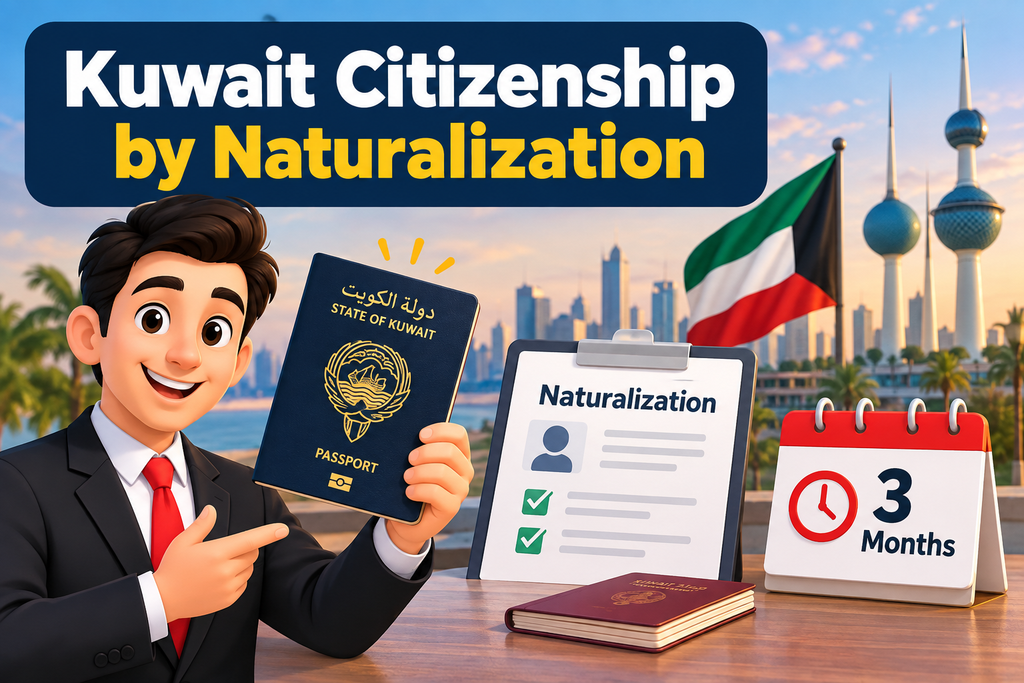
Three-month renunciation requirement
New Article 11 bis requires a person who acquires Kuwaiti nationality through naturalization and holds another nationality to:
- renounce the other nationality within three months of obtaining Kuwaiti nationality
- provide proof of that renunciation to the Ministry of Interior within the same period.
In case the person fails to comply, the granting of Kuwaiti nationality would be revoked from the date it was granted.
What Happens to Kuwaiti Women Who Marry Foreign Nationals?
Care needs to be taken with the current law, as there are various situations.
The amended Article 10 does not mean that the nationality of a Kuwaiti woman cannot be changed because she marries a foreign national.
The provision, however, provides that in the event she gets the nationality of her foreign husband, she loses Kuwaiti nationality.
Can Kuwaiti Women Recover Their Nationality?
Women who are covered by Article 1 and lost their Kuwaiti nationality by acquiring the nationality of a foreign husband can demand to restore their Kuwaiti nationality after termination of marriage.
The reinstatement is effected by decree, and it can be done by her requesting it when:
- her habitual residence is in Kuwait; or
- she has returned to Kuwait to reside there.
The provision establishes a clear and distinct avenue to restore nationality in cases where a marriage dissolves, instead of automatically restoring nationality when a marriage is terminated.
What Are the Rules for Children of Kuwaiti Mothers?
The law of 2026 cannot be called an automatic rule where all the children of the mother automatically become Kuwaiti by origin.
It amends Art. 7 bis A, which sets the circumstances under which the Minister of Interior may consider a minor born from a Kuwaiti mother to be Kuwaiti until he/she reaches adult age.
Including situations where the foreign father:
- is a prisoner of war;
- has irrevocably divorced the child’s mother; or
- has died.
The provision also covers some children when their father was unknown, and the paternity was not confirmed to the child who was born to a Kuwaiti mother, in addition to children born in Kuwait to unknown parents.
When Can Kuwaiti Nationality Be Lost?
Withdrawal or revocation of a nationality does not always translate into loss of nationality.
The revised nationality law has special provisions covering the following:
- loss of nationality;
- withdrawal of nationality from certain naturalized citizens;
- revocation or cancellation in specified circumstances; and
- nationality acquired through fraud or false information.
Article 11 stipulates the loss of Kuwaiti nationality for any Kuwaiti who acquires a foreign nationality voluntarily, distinguishing and excluding the circumstances spelled out in the provision.
Its impact will vary based on the individual’s nationality: Kuwaiti-born or naturalized.
When Can Kuwaiti Nationality Be Withdrawn?
The changes in Article 13 provide for four conditions under which Kuwaitis can presume it was granted to a foreigner by mistake.
Withdrawal as a result of a proposal by the Minister of Interior approved by the relevant higher nationality committee by decree.
This is not just to say that the government can “cancel citizenship whenever it wants”. The law provides for withdrawal from the blood transfusion in accordance with the applicable provisions.
When Can Kuwaiti Nationality Be Revoked?
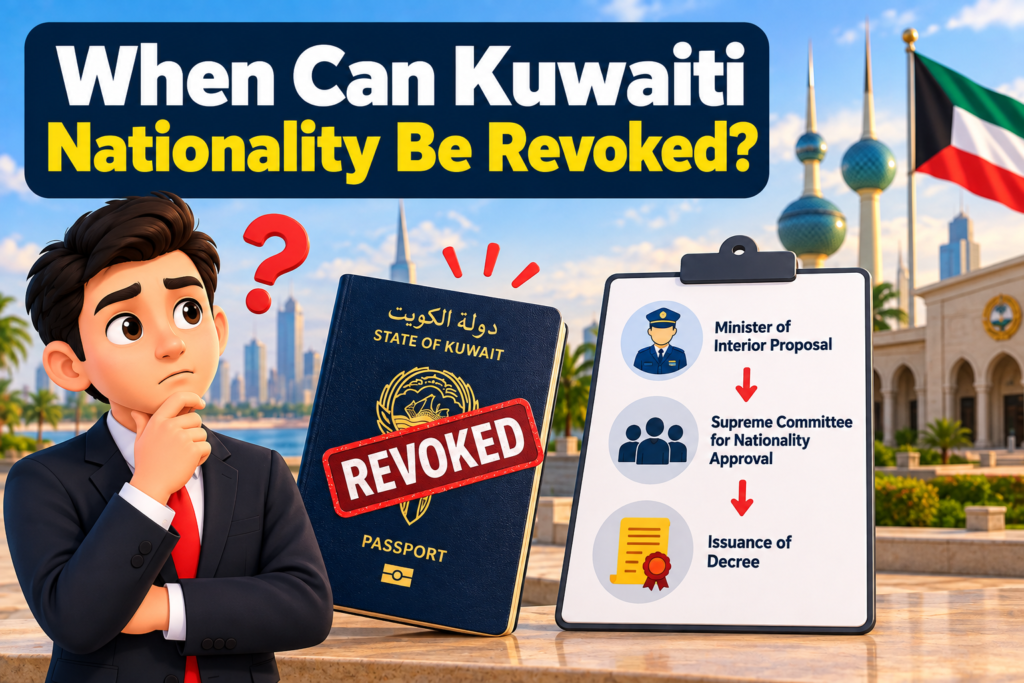
The previously mentioned article (14 bis) has been modified and now allows Kuwaiti nationality to be withdrawn by decree for the conditions provided by the law.
The process involves:
- a proposal from the Minister of Interior;
- approval by the Supreme Committee for Nationality; and
- issuance of the relevant decree.
The legal basis is not a thing to care about – nationality withdrawal is not to be confused with nationality revocation.
New Grounds and Procedures for Nationality Revocation
Withdrawal and revocation were expanded upon in the 2026 amendment.
The changes include provisions on the loss of nationality and cases in which nationality can be withdrawn or revoked, and the status of those who acquired nationality through naturalization.
Furthermore, the amendment adds consequences for fraudulent or false documents for acquiring citizenship.
According to Article 21 bis A, the nationality certificate of Kuwaiti nationality may be revoked if it is found that a certificate of nationality might have been issued illegally based on the grounds of:
- fraud;
- false statements; or
- incorrect testimony.
The provision may likewise impact individuals who become Kuwaiti nationals by means of their dependency on a person holding a certificate.
Can Kuwait Use DNA Testing in Nationality Cases?
Yes.
The amended Article 20 clearly allows the application of scientific methods for matters of nationality.
These methods can include:
- DNA testing;
- biometric identification; and
- other scientific methods permitted under the applicable rules.
The provision pertains to investigations related to loss, withdrawal, and revocation of nationalities and mandates its application in line with rules and controls promulgated by the Minister of the Interior.
Penalties for False Information
To strengthen penalties for the provision of false information to agencies in nationality proceedings, the 2026 amendment provided for increased penalties.
According to a new amendment to Article 21 bis B, a person who submits false information to the authorities or a committee that requests that kind of information shall otherwise be subject to:
- imprisonment of up to three years; and
- a fine of up to KWD 3,000.
Kuwait Nationality Law:
Kuwaiti by origin
A person who falls within the categories defined under Article 1 of the nationality law, including qualifying persons born to a Kuwaiti father by origin.
Kuwaiti by naturalization
An individual who became a Kuwaiti citizen as a result of the naturalisation process as opposed to being born in Kuwait.
Loss of nationality
Loss of nationality on a specific basis set by the Nationality Act.
Withdrawal of nationality
Nationality acquisition based on the conditions and authority given in the provisions, such as Article 13.
Revocation
Article 14 bis and the related items of the Constitution are a separate legal arrangement.
Read Also: Kuwait Independence Day 2027: Date, History & Facts
Frequently Asked Questions (FAQs)
What is the Kuwait Nationality Law?
It governs Kuwaiti citizenship, including acquisition, naturalization, loss, withdrawal, and revocation.
What is the latest Kuwait nationality law?
Decree-Law No. 52 of 2026, published on April 13, 2026, is the latest major amendment.
What changed in 2026?
Changes cover naturalization, nationality by origin, dual nationality, children, citizenship loss, withdrawal, revocation, and nationality investigations.
Can someone born to a Kuwaiti father get citizenship?
Yes. Article 1 provides nationality by origin to qualifying people born to a Kuwaiti father by origin.
Final Takeaway
The nationality framework has seen significant changes in its framework, and Decree-Law No.52 of 2026 is especially significant for any researcher interested in Kuwait’s citizenship today.
The present system provides for the concept of two types of nationality, namely nationality of origin and nationality acquired by naturalization; it adds a three-monthbackout period for naturalized citizens who have other nationalities, fines for misleading responses, introduces new provisions concerning children and spouses, elevates provisions on rescission and withdrawal and makes provisions for judicial review in instances of investigation, where it is expected that scientific verification will be used.